politics
Economics of Global Tariff War
By Dr Mehraj Ud Din Shah | Sat Jul 04 2026
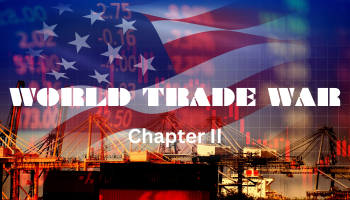
A significant tariff war was looming around the globe in late 2025 and early 2026. Its headwinds were sure to slip many nations into economic stagnation, including the US. Nonetheless, the apparent small pause is unsupportive to set the order right. The tariff policy corrections demand core macroeconomic analysis and estimations; otherwise, shooting arrows in the air doesn’t scare the enemies.
In the International Trade landscape, the tariff wars have a long history. They have been happening even before 1839. Nevertheless, since 2018, the tariff war has gained heightened momentum, when the US and China engaged in retaliatory tariff attacks. This panorama at first instance shook the edifice of the free trade framework of the World Trade Organization (WTO) and drove the nations to revisit their tariff policies with exclusive inward-looking objectives. Factually, the global tariff war reveals a complex interaction between national interests and global economic efficiency. While the tariffs may provide a temporary advantage to selected industries and serve some strategic policy objectives of a country. However, their broader economic effects are generally negative.
While this tariff war added new trade opportunities for the Indian economy. India emerged as one of the countries that benefited from companies seeking alternatives to China.
The recent tariff war of 2025 and early 2026 that the USA has initiated against some of its ideological rivals, like China, Mexico, Canada, India etc. has created global ripple effects in business and trade. It unleashed an undesirable impact on the global business environment and consumer income and savings. Admittedly, it may have augmented domestic demand and consumption of US goods, and helped the country to generate some additional cash flows to recompose its revenue arithmetic. Unfortunately, this double-edged knife had cut the US economy sharply. It has caused a reduction in their real income, savings, and has led to the postponement of their current consumption and demand. The fluid shock had reduced production, employment, and GDP in the US to -1.4% in 2025 (down from expectations of 1.9% ) say experts. However, the critical argument is how the move has impacted the economies of China, Mexico, Canada, and other broader parts of the world, against which the tariff war was not directly aimed. It did impact China’s electronics, machinery, and consumer goods industries and slowed their production and employment. However, China identified new partners and diversified its export market, strengthened its trade relations, and substituted the US to a greater extent. Similarly, Mexico observed the nearshoring of US companies in Mexico. This augmented the production, employment, and income in Mexico and pulled down the consequent US revenue flows. Canada also forged new trade relations and minimised the adverse fallout of tariffs spike. While this tariff war added new trade opportunities for the Indian economy. India emerged as one of the countries that benefited from companies seeking alternatives to China. It increased foreign investment into sectors such as electronics, pharmaceuticals, and manufacturing. The Indian government promoted initiatives like "Make in India" to attract global businesses. However, India also faced challenges, including competition from other emerging economies and disruptions in global supply chains that affected its exports and imports. Conversely, many Southeast Asian Countries, including Vietnam, Thailand, and Malaysia, benefited as multinational companies moved production away from China. These countries attracted new investments and increased exports. Nevertheless, it is pertinent to acknowledge that the countries that were heavily integrated into global supply chains experienced disruptions and increased costs. Higher tariffs reduced trade efficiency and contributed to their slower global economic growth. Developing countries dependent on international trade were particularly vulnerable to fluctuations in demand and investment.
The global onslaught of tariff wars is enormous and beyond the scope of exact estimation. A recent research report on tariff war hints that the cost of the global tariff war was not less than $1.7 trillion in 2014 and had a profound negative impact on the GDP of all countries. The average country's real GDP had fallen by 2.8%. Rightly, the buoyancy and adverse fallout of the renewed tariff war have doubled over the previous tariff war, and its adverse effects are more daunting and economically catastrophic. This had halted the economic transition and momentum of the emerging economies that are heavily dependent on intermediate input trade. Moreover, the recent tariff war had unfolded new opportunities for many countries, especially for ASEAN, to replace China and gain access to export markets in countries where China had significant presence. Factually, it had given a big dent to China’s Information and Technology Industry and somewhat added benefit to India's Information and Technology sector. While in China, the panorama had augmented its Research and Development (R&D) budget and enhanced its competitive ability, thereby it would yet again emerge as a net gainer from this Tariff War.
Needless to mention, China spends around $785 billion annually on Research and Development, which is roughly about 2.6% of its GDP. While India and Japan together spend only $ 276 billion annually, which is somewhat less than 0.7% and 3.4% of their GDP, respectively. China's absolute spending is over ten times higher than India's, and almost four times that of Japan, creating a vast disparity in technological innovation and infrastructure scale. The whopping budget of China on R&D certainly would emerge as a driving force for its export sector, and over the years, the US Tariff War initiatives would prove meaningless and irrelevant to the global world order. Further, the deglobalization framework that the US is contemplating to strengthen in the years to come would become its core economic disadvantage. Consequently, there is an apprehension for the US to lose the markets that it largely controls under its geopolitical spectrum. The new world trade order would be significantly governed by the comparative cost and technological advantage rather than the geopolitical considerations.
Therefore, for the fitness of the global business ecosystem, tariff wars have no place, and protectionism should no longer be a relevant trade ideology of nations. The countries shall invest excessively in technology and innovate their products that benefit the masses around the globe. This system alone will protect global resources and augment overall growth. The ideology of dictating to nations to buy or not to buy from certain nations is nothing more than economic misguidance. The nations should learn to safeguard their economic interests and protect its resources.
________________________________________________________________-
*Dr Mehraj Ud Din Shah, Associate Professor, Department of Commerce, Central University of Kashmir, Green Campus, Ganderbal. Email: drshshmehraj@cukashmir.ac.in
Related Articles
The Decade of Connectivity How Roads, Railways and Digital Networks Are Reshaping Kashmir
Yawar Yousef/Yasir Lone
For much of its modern history, Kashmir has been discussed through the language of conflict, diplomacy, security, and constitutional politics. Governments changed, policies evolved, and public debates shifted, yet the dominant narratives surrounding the region remained remarkably consistent.
Waiting for a Vacancy Education, Aspiration and the Politics of Waiting in Kashmir
Suhail Bhat
At six o'clock on a cold winter morning, long before the markets of Srinagar begin to stir and before office-goers emerge onto the roads, hundreds of young men and women can already be seen standing outside examination centres.
Kashmir and the New Asian Geopolitics How China’s Rise is Reshaping the Strategic Environment
KC Desk
For much of the twentieth century, the Kashmir region was understood through a relatively stable analytical framework. It was a territorial and political conflict between India and Pakistan, shaped by Partition, sustained by competing claims of sovereignty, and periodically intensified by military confrontation.

Shri Amarnath Ji Yatra: Where Faith Meets the Spirit of India
Mohammad Zaid Malik
Every summer, as the Himalayan winter loosens its grip and the snow begins to retreat from the high-altitude passes of Kashmir, a remarkable human movement begins to unfold. It is not driven by trade, tourism, or migration. It is driven by faith.
The Unheard Kashmir — Governance, Dependency and the Crisis of Representation in Pakistan Administered Kashmir
Bashir Assad
For nearly eight decades, the Himalayan region of Kashmir has occupied a unique place in international politics. It has generated wars, shaped national identities, influenced military doctrines, and drawn the sustained attention of diplomats, scholars, and policymakers across the world.
The Protest That Won’t Go Away
Rafi Ahmad Mir
Pakistan-administered Kashmir and the limits of political management