culture
Economic Potential in Jammu and Kashmir- Part-I
By Dr Mehraj Ud Din Shah | Thu Nov 05 2026
This anecdote attempts to uncover the economic potential of Jammu and Kashmir through a multidimensional analysis of its primary, secondary and tertiary sectors. It explores the prospects of agriculture, horticulture, tourism, handicrafts, food processing, renewable energy, information technology, education, healthcare and small-scale manufacturing. The anecdote also evaluates the institutional, infrastructural, financial and environmental factors influencing regional economic development.
Factually, Jammu and Kashmir is endowed with distinctive economic resources and potential. It has phenomenal geographical location, vast natural resources, agro-climatic diversity, horticultural wealth, tourism assets, hydropower capacity, traditional handicrafts and growing opportunities in services, entrepreneurship and digital commerce. Moreover, the quality of its human resources, reputable intellect and professional stewardship in education, medicine, engineering, law and other diverse domains are unmatchable. Nevertheless, the full productive capacity of the region remains constrained by structural bottlenecks, including inadequate industrial diversification, limited access to large markets, high transportation costs, seasonal employment, fragmented agricultural supply chains, environmental vulnerability and uneven access to finance and technology.
Rightly, Jammu and Kashmir represents a distinctive case of regional economic development in India. The state has a high potential for economic change, improvement and sustained development through the joint operation of traditional and emerging sectors. The traditional activities possess established skills, cultural identity and market recognition, whereas emerging activities require stronger technological capabilities, modern infrastructure and investment.
Factually, Jammu and Kashmir is endowed with distinctive economic resources and potential. It has phenomenal geographical location, vast natural resources, agro-climatic diversity, horticultural wealth, tourism assets, hydropower capacity, traditional handicrafts and growing opportunities in services, entrepreneurship and digital commerce.
Looking at the domain through the sectoral sense, agriculture sector still plays a vital role in the regional economy by providing employment, supporting rural livelihoods, ensuring food security, and supplying raw materials to agro-based industries. The sector comprises traditional agriculture, horticulture, floriculture, dairy farming, poultry, fisheries, and other allied activities. Its development is supported by diverse agro-climatic conditions, fertile valleys, and favourable environments for cultivating cereals, vegetables, fruits, spices, and dry fruits. The sector is still wrapped in many flaws in terms of low productivity, farm fragmentation , low technology infusion etc. However, this sector is gradually moving towards modern orchard development, vegetable diversification and digital agricultural marketing. The sector's potential lies in increasing productivity, strengthening cold-chain infrastructure, expanding food processing, promoting organic and high-value crops which is commercially viable, and improving farmers' access to markets. Moreover, its potential for development is also linked to agricultural diversification like vegetables, berries, mushrooms, floriculture, apiculture, medicinal and aromatic plants, and regionally appropriate subtropical fruits can broaden rural income sources. However, diversification should be based on agro-climatic suitability, water availability, market demand and farmers' risk-bearing capacity rather than indiscriminate promotion of new crops. Further, digital trading through e-NAM, better post-harvest management and value-added products can improve price realisation and reduce losses. Achieving this transformation requires shifting the policy emphasis from production alone towards value addition, stable farm incomes, climate resilience and stronger links between farmers, processors and consumers. Nevertheless, limited cultivable land, rainfed farming, climate risks, fragmented holdings and price fluctuations remain important challenges.
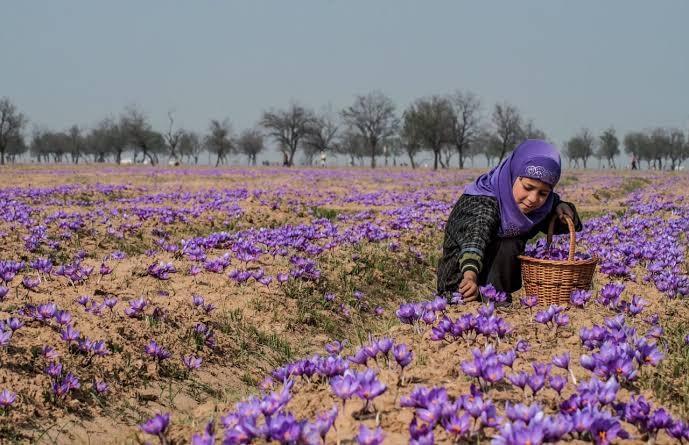
Apart from agriculture, horticulture needs a total policy reform for realizing its potential benefit. The horticulture sector accounts for approximately 6–7% of the Jammu and Kashmir GSDP and provides direct and indirect employment to a substantial population. The Economic Survey 2025–26 reports that the area under major horticultural crops reached approximately 3.47 lakh hectares by November 2025, while the area under high- and medium-density plantations expanded to approximately 20,034 hectares. It also reports growth in mushroom and honey production during 2024–25. Horticulture has a vast potential to transform the economy of the state. Rightly, the economic significance of horticulture extends beyond the farm. It creates demand for nursery development, fertilisers, packaging materials, harvesting labour, transport, cold storage, grading, wholesale markets, processing facilities and export services. Moreover, food processing. apples can be converted into juice, vinegar, dried fruit, puree and other processed products. Walnuts and almonds offer opportunities for cleaning, grading, kernel extraction, packaging, confectionery ingredients and edible oils. Saffron can support premium packaging, traceability and specialised food products. These activities can increase the value retained within the region rather than allowing a disproportionate share of profits to accrue to intermediaries elsewhere. Consequently, investment in horticultural value chains can stimulate several interconnected economic activities. There is a strong need for modernizing orchards, replacing unproductive and ageing orchards with suitable high-density plantations, improved planting material, scientific pruning, efficient irrigation and integrated pest management can increase productivity per hectare. ICAR identifies old orchards, low-density planting and disease-related losses among the constraints affecting apple productivity and recommends modern orchard-management practices. The sector also needs efficient post harvest management. Modern packhouses, pre-cooling facilities, controlled-atmosphere storage, scientific grading and refrigerated transportation can reduce spoilage and improve market timing. NITI Aayog reports that cold-storage capacity increased from approximately 1.51 lakh tonnes in 2020–21 to 2.70 lakh tonnes in 2023–24. Continued investment should be guided by district-level demand, utilisation rates, energy costs and commercial viability.
The official Economic Survey 2025–26 estimates tourism's contribution at around 7% of GSDP and reports that the sector supports approximately five lakh livelihoods directly and indirectly. There are significant opportunities for all time tourism , rural tourism, adventure tourism, pilgrimage tourism, heritage tourism, eco-tourism and other specialised segments.
Along with the horticulture sector, tourism is the profound sector that can shape bright economic future of the state of Jammu and Kashmir. Tourism is among the most visible sources of economic potential in Jammu and Kashmir. The region combines natural landscapes, lakes, mountains, gardens, pilgrimage centres, cultural traditions, adventure destinations and distinctive local cuisine. Its tourism assets serve different categories of visitors, including leisure travellers, pilgrims, families, adventure enthusiasts and visitors seeking rural or cultural experiences.
The official Economic Survey 2025–26 estimates tourism's contribution at around 7% of GSDP and reports that the sector supports approximately five lakh livelihoods directly and indirectly. There are significant opportunities for all time tourism , rural tourism, adventure tourism, pilgrimage tourism, heritage tourism, eco-tourism and other specialised segments. All time tourism must be the agenda of the tourism policy. Developing activities across different seasons can reduce excessive dependence on peak summer and winter periods. Winter sports, autumn tourism, spring gardens, trekking, birdwatching and cultural events can support more continuous demand. Pushing rural and community-based tourism, carefully regulated homestays, village experiences, local cuisine, traditional architecture and farm-based tourism can distribute income beyond major urban and resort centres. Pilgrimage tourism can give added boost to tourism in the state. Jammu and Kashmir’s pilgrimage economy provides opportunities for accommodation, transport, food services, sanitation, retail trade and visitor-management services. Better planning can improve visitor experience while protecting local infrastructure and the environment. Moreover, adventure tourism like trekking, mountain biking, skiing, mountaineering and other outdoor activities can support specialised businesses. Their expansion requires trained guides, rescue systems, insurance, safety standards and environmental management. Further, promotion of tourism for meetings, conference facilities and professionally managed events can attract institutional, business and academic visitors, potentially extending tourism demand beyond conventional holiday periods. Nevertheless, there is also an urgent need for managing local production services, event management, cultural programming and destination-based events can generate additional demand for accommodation, transport, catering and skilled workers.
to be continued in part-II………….
*Dr Mehraj Ud Din Shah, Head , Department of Commerce, Central University of Kashmir, Ganderbal
Related Articles
The Indus Waters Treaty in Abeyance: Separating Facts from Rhetoric
Devendra Kumar Sharma
The Indus Water Treaty (IWT), signed in Karachi on September 19, 1960, by the Indian Prime Minister Jawaharlal Nehru and Pakistani President Ayub Khan, was a historic water-sharing Agreement.

The Connectivity Conundrum: Hybrid Vulnerabilities in the Trans-Regional Grid
Insha Sofi
For generations, the primary objective of the security architecture in Jammu and Kashmir was defined by predictable paradigms. The state apparatus focused on securing urban population centers against street agitation, while simultaneously reinforcing the multi-layered counter-infiltration grids along the Line of Control.
The Silicon Ravine: Global Capital, Remote Tech, and Kashmir’s Sovereign Digital Frontier
Sohail Bhat
In the quiet, low-lit cafes lining the Bund in Srinagar and within the minimalist co-working spaces cropping up across Srinagar and Jammu, a quiet macro-economic transformation is unfolding.
The Durbar Move Dilution and the Winter Secretariat Model
Kashmir Central Desk
For nearly a century and a half, the seasonal rhythm of governance in Jammu and Kashmir was dictated by a monumental administrative migration. Introduced in 1872 by Maharaja Gulab Singh, the bi-annual Darbar Move saw the entire government machinery-complete with thousands of employees, ministers, and truckloads of official files-pack up and travel across the treacherous Jammu–Srinagar National Highway.
The Pulpit vs. The State: The Waqf Board Backlash
Intikhab Alam
For generations, the Friday congregational prayer across the Kashmir Valley has served as a profound spiritual anchor and a mirror to contemporary society. The Mimbar, or pulpit, has stood as a sacred yet highly contested space where the religious, social, and political currents of the territory converge.
Beyond the Pomp: The Logistical Strain of the 3-Tier Local Governance Promise
Bashir Assad
For twenty-eight thousand former Panchayat members across the fractured valleys and rugged highlands of Jammu and Kashmir, democracy has long been an exercise in prolonged anticipation. Following the highly publicized Assembly elections that finally restored a regional legislative assembly, the focus has abruptly shifted from the grand statecraft of the civil secretariat to the unpaved alleys of rural development.