society
Detailed Concept Note
By Dr Mehraj Ud Din Shah | Wed Oct 07 2026
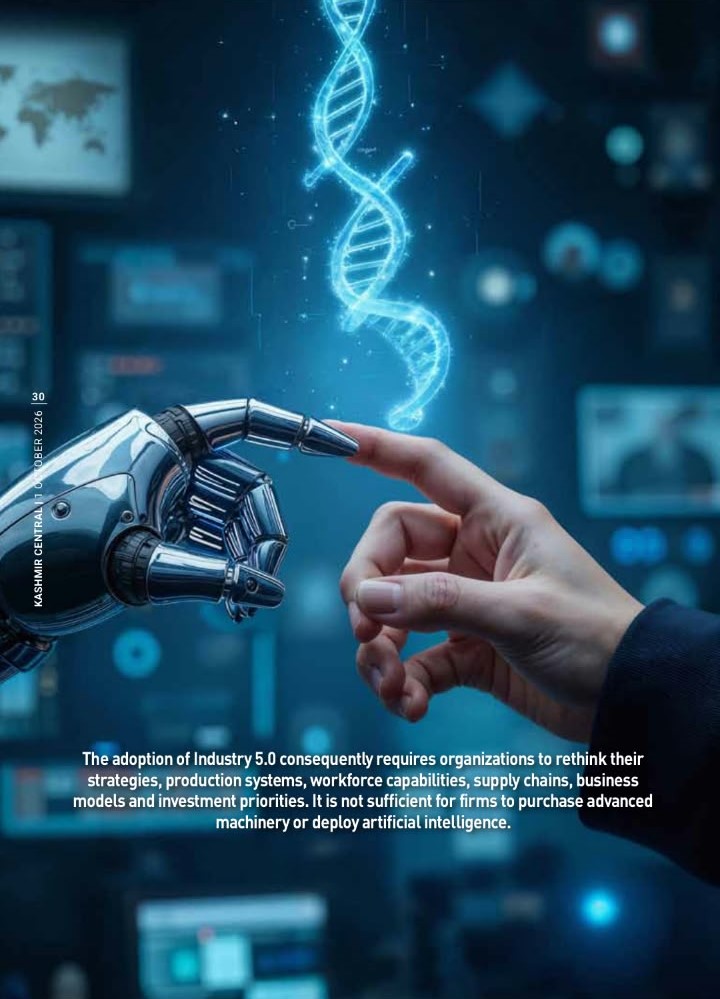
Industry 5.0 Adoption: Strategic Transformation and Critical Challenges
1. Introduction
The global industrial landscape is undergoing a fundamental transformation as businesses move beyond the automation- and efficiency-oriented paradigm of Industry 4.0 toward a more human-centric, sustainable and resilient model commonly referred to as Industry 5.0. While Industry 4.0 emphasized cyber-physical systems, industrial Internet of Things (IIoT), cloud computing, big data, artificial intelligence (AI), robotics and automation, Industry 5.0 seeks to integrate these technologies with human creativity, organizational resilience and environmental sustainability. The concept therefore represents not merely another stage of technological advancement, but a broader reorientation of industrial strategy in which technology is expected to serve economic, social and environmental objectives simultaneously.
Industry 5.0 has emerged in response to the limitations and unintended consequences associated with highly automated and technology-intensive production systems. Although Industry 4.0 has enabled substantial improvements in productivity, flexibility, predictive maintenance, quality control and supply-chain coordination, its implementation has also raised questions concerning worker displacement, digital inequality, cybersecurity, excessive dependence on technology, resource consumption and the vulnerability of globally interconnected production networks. Industry 5.0 attempts to address these concerns by placing human beings, sustainability and resilience at the centre of industrial transformation.
The adoption of Industry 5.0 consequently requires organizations to rethink their strategies, production systems, workforce capabilities, supply chains, business models and investment priorities. It is not sufficient for firms to purchase advanced machinery or deploy artificial intelligence. Successful adoption requires organizational transformation in which technological capabilities are aligned with human skills, institutional structures, sustainability objectives and long-term business strategy. This makes Industry 5.0 adoption a multidimensional transformation rather than a conventional technology-upgradation exercise.
2. Conceptual Understanding of Industry 5.0
Industry 5.0 can broadly be understood as an industrial paradigm that combines advanced digital technologies with human-centricity, sustainability and resilience. The central proposition is that the future of manufacturing should not be determined exclusively by machines, algorithms and autonomous systems. Instead, technology should complement human capabilities and enable workers to perform tasks that require creativity, critical thinking, judgment, adaptability and problem-solving.
The concept introduces a shift from the question of how much can be automated? toward the broader question of how can humans and intelligent technologies collaborate to create better economic, social and environmental outcomes? Under this framework, robots, AI systems and automated production technologies are not necessarily substitutes for human labour. They can function as collaborative tools that augment human capabilities.
For example, in a conventional automated manufacturing environment, a robotic system may be designed to perform a particular production task with minimal human intervention. Under an Industry 5.0 model, the same robotic system may work collaboratively with an employee, handling repetitive or physically demanding operations while the worker supervises processes, interprets information, resolves exceptions and exercises judgment. This concept of human-machine collaboration represents one of the defining characteristics of Industry 5.0.
Industry 5.0 also expands the objectives of industrial production. Productivity and profitability remain important, but they are considered alongside employee well-being, environmental sustainability, resilience of operations and the broader social consequences of technological change.
3. Rationale for Industry 5.0 Adoption
The movement toward Industry 5.0 is driven by several structural changes in the global economy. One major factor is the increasing complexity of production systems. Modern supply chains depend on multiple countries, suppliers, logistics networks and digital platforms. Disruptions caused by pandemics, geopolitical tensions, natural disasters, trade restrictions and energy shocks have demonstrated the vulnerability of highly interconnected production networks. Organizations therefore require systems capable of adapting rapidly to unexpected disruptions.
Another important driver is the increasing pressure for environmental sustainability. Manufacturing industries are major consumers of energy and raw materials and contribute significantly to greenhouse-gas emissions and waste generation. Governments, consumers, investors and international institutions are increasingly demanding environmentally responsible production. Industry 5.0 provides a framework through which digital technologies can be used not merely to increase output but also to optimize energy consumption, reduce material waste, improve resource efficiency and support circular production.
A third driver is the changing nature of work. Automation is increasingly taking over repetitive and predictable activities, while demand is growing for workers capable of operating, supervising and collaborating with sophisticated technological systems. Industry 5.0 therefore emphasizes continuous learning, reskilling and the development of human capabilities alongside technological investments.
The fourth driver is the growing demand for personalization. Consumers increasingly expect products tailored to their preferences, creating a need for flexible production systems capable of producing customized goods at economically viable costs. Industry 5.0 technologies can facilitate such mass customization by combining automation with human decision-making and flexible manufacturing systems.
4. Strategic Transformation Under Industry 5.0
Industry 5.0 adoption requires transformation across multiple dimensions of an organization.
4.1 Transformation of Business Strategy
The first requirement is the integration of Industry 5.0 into the organization's overall strategic vision. Technology adoption should not be treated as an isolated IT or production-management initiative. Senior management needs to determine how AI, robotics, digital twins, advanced analytics and collaborative technologies can contribute to the organization's long-term objectives.
A strategic transformation involves identifying processes where technology can generate measurable value while preserving or enhancing human capabilities. Organizations must therefore develop technology roadmaps that link investments in advanced technologies with productivity, sustainability, employee development, customer experience and resilience objectives.
The strategic emphasis also changes from short-term technological adoption to long-term organizational capability building. Purchasing sophisticated equipment without developing the workforce and organizational processes required to use it effectively can produce limited returns.
4.2 Transformation of Production Systems
Industry 5.0 requires manufacturing systems to become increasingly flexible, intelligent and adaptive. Smart machines equipped with sensors can continuously collect operational information, while AI and analytics can identify production abnormalities, forecast equipment failures and optimize production schedules.
Digital twins can create virtual representations of physical production systems, allowing organizations to simulate processes before implementing changes in real production environments. This can reduce experimentation costs and enable more efficient planning.
Collaborative robots, commonly known as cobots, are particularly relevant because they can work alongside human operators. Rather than completely replacing employees, these systems can perform repetitive, dangerous or physically demanding tasks while humans undertake activities requiring judgment, creativity and problem-solving.
5. Human-Centric Transformation
Human-centricity represents one of the most important distinctions between Industry 4.0 and Industry 5.0. The objective is not simply to place workers inside increasingly automated environments but to design technologies around human capabilities and needs.
This requires organizations to rethink job design. Employees may increasingly become supervisors of automated systems, data interpreters, maintenance specialists, process analysts and problem-solvers rather than performing repetitive manual activities.
Consequently, reskilling and upskilling become central components of Industry 5.0 adoption. Workers may require knowledge of data analytics, digital systems, robotics, cybersecurity and AI while simultaneously retaining domain-specific expertise.
The transformation also involves employee participation. Workers who understand production processes possess valuable practical knowledge that can improve technology implementation. Organizations that involve employees in the design and deployment of new technologies can potentially reduce resistance and improve adoption.
Human-centric Industry 5.0 therefore requires a balance between technological efficiency and employee well-being. Excessive workplace monitoring, algorithmic management or poorly designed automation can generate stress and reduce autonomy. The implementation of technology should consequently consider occupational health, worker privacy, ergonomics and meaningful employment.
6. Sustainability Transformation
Sustainability is another foundational pillar of Industry 5.0. Industrial organizations are increasingly expected to reduce their environmental footprint while maintaining competitiveness.
Advanced digital technologies can contribute to this objective in several ways. Sensors can monitor energy consumption in real time, AI can optimize production schedules to reduce energy use, predictive systems can extend equipment life, and digital platforms can improve resource utilization.
Industry 5.0 also supports the development of circular manufacturing systems. Instead of following a linear model of extracting resources, producing goods, consuming them and generating waste, organizations can use digital technologies to support repair, reuse, remanufacturing and recycling.
However, sustainability cannot be assumed merely because a factory becomes more digital. Advanced technologies themselves require energy, computing infrastructure, rare materials and electronic components. Therefore, organizations must evaluate the complete environmental lifecycle of their technologies rather than equating digitalization automatically with sustainability.
7. Resilience and Risk Management
Resilience constitutes the third major pillar of Industry 5.0. Modern production networks must be capable of continuing operations—or recovering rapidly—when confronted with unexpected disruptions.
Digital technologies can improve resilience by providing real-time visibility across production and supply-chain networks. AI-based forecasting can identify potential disruptions, while digital twins can simulate alternative scenarios. Flexible production systems can allow organizations to change suppliers, production schedules or manufacturing processes more rapidly.
Supply-chain resilience also requires diversification. A technologically advanced factory may remain vulnerable if it depends on a single supplier for a critical component. Industry 5.0 therefore requires technological transformation to be accompanied by strategic supply-chain management.
8. Critical Challenges in Industry 5.0 Adoption
Despite its potential, Industry 5.0 adoption involves substantial challenges.
8.1 High Investment Requirements
Advanced robotics, AI systems, IoT infrastructure, digital twins, cloud platforms and cybersecurity systems require significant investment. This can create difficulties for small and medium-sized enterprises (SMEs), which may lack the financial resources required for large-scale digital transformation.
The challenge is particularly significant when firms cannot clearly estimate the return on investment. Industry 5.0 benefits may emerge over several years through improved resilience, employee productivity, sustainability and innovation rather than through immediate cost reductions.
8.2 Skills Gap
One of the most significant barriers is the shortage of employees capable of operating advanced technologies. Industry 5.0 requires multidisciplinary capabilities combining engineering, information technology, data analysis and managerial skills.
The challenge is not limited to hiring new employees. Existing workers must also be continuously trained as technologies evolve. This creates an ongoing organizational commitment to lifelong learning.
8.3 Organizational Resistance
Technological transformation frequently encounters resistance from employees and managers. Workers may perceive automation as a threat to employment, while managers may be reluctant to change established processes.
Industry 5.0 therefore requires effective change management. Employees need to understand how technologies will affect their roles, what new skills they will require and how the transformation can improve workplace conditions.
8.4 Cybersecurity Risks
Greater connectivity increases exposure to cyber threats. Manufacturing systems increasingly connect machines, enterprise software, suppliers and cloud platforms. A cybersecurity breach can therefore interrupt production, compromise sensitive information or create physical safety risks.
Industry 5.0 requires cybersecurity to be integrated into system design rather than treated as an additional layer after implementation.
8.5 Data Privacy and Governance
Industry 5.0 systems depend heavily on data. Organizations may collect information concerning production performance, employee activities, machine operations and customer preferences.
This raises questions concerning data ownership, privacy, transparency and responsible use. Firms need governance frameworks that establish who can access data, how it can be used and how sensitive information is protected.
8.6 Integration with Legacy Systems
Many industrial organizations continue to operate machinery and software developed before the emergence of modern digital technologies. Integrating these legacy systems with IoT, AI and cloud platforms can be technically complex and expensive.
Replacing entire production systems may also be economically unrealistic. Organizations therefore need strategies for gradual modernization and interoperability.
8.7 Ethical Challenges of Artificial Intelligence
AI systems can influence recruitment, workforce allocation, quality assessment, production decisions and performance monitoring. If these systems are poorly designed, they may introduce bias or make decisions that employees cannot understand or challenge.
Industry 5.0 consequently requires responsible AI principles emphasizing transparency, accountability, human oversight and fairness.
9. Industry 5.0 and SMEs
Small and medium-sized enterprises face a distinctive set of challenges. Unlike large multinational corporations, SMEs may have limited access to capital, specialized technical personnel and advanced digital infrastructure.
Nevertheless, Industry 5.0 does not necessarily require SMEs to transform their entire operations simultaneously. A phased approach can begin with relatively focused applications such as predictive maintenance, energy monitoring, inventory optimization or collaborative robotics.
Government policies, industry associations, technology providers and research institutions can play an important role by providing financing, technical assistance, training and shared technological infrastructure.
10. Industry 5.0 Adoption Framework
A practical Industry 5.0 adoption strategy can be conceptualized as a series of interconnected stages.
First, organizations should conduct a readiness assessment. This involves evaluating existing technologies, workforce skills, infrastructure, financial capacity, cybersecurity maturity and organizational culture.
Second, organizations should establish strategic priorities. Rather than adopting technologies because they are fashionable, firms should identify specific operational or strategic problems that technology can address.
Third, organizations should develop a phased technology roadmap. Pilot projects can be implemented in selected areas before organization-wide deployment.
Fourth, workforce transformation should occur simultaneously. Training and reskilling should begin before employees are expected to operate new systems.
Fifth, sustainability and resilience indicators should be incorporated into performance measurement. Productivity alone should not determine whether an Industry 5.0 project is successful.
Finally, organizations should establish continuous evaluation mechanisms. Industry 5.0 is not a one-time transformation because technologies, markets and workforce requirements continuously evolve.
11. Proposed Conceptual Model
The relationship can be represented conceptually as:
Industry 5.0 Technologies ↓ AI + Robotics + IoT + Digital Twins + Big Data + Automation ↓ Human–Technology Collaboration ↓ Improved Productivity + Innovation + Customization ↓ Strategic Transformation ↓ Human-Centricity + Sustainability + Resilience ↓ Organizational Outcomes ↓ Operational Performance + Environmental Performance + Workforce Development + Supply-Chain Resilience + Long-Term Competitiveness
The model also recognizes that adoption is influenced by several moderating factors, including financial capacity, workforce skills, organizational culture, leadership commitment, cybersecurity readiness, regulatory environment and technological infrastructure.
12. Research Perspective
From an academic perspective, Industry 5.0 adoption offers an important area for interdisciplinary research. It connects industrial engineering, strategic management, economics, human-resource management, information systems, sustainability studies and organizational behaviour.
Future research can investigate whether Industry 5.0 actually improves productivity while simultaneously enhancing employee well-being and environmental performance. Researchers can also examine whether human-machine collaboration creates new forms of employment or primarily restructures existing occupations.
Another important research question concerns the economic implications of Industry 5.0. While automation can reduce certain production costs, investments in advanced technologies, cybersecurity, training and infrastructure can increase short-term expenditure. Understanding the long-term cost-benefit relationship is therefore essential.
Research can also examine differences between large enterprises and SMEs, developed and emerging economies, and labour-intensive and capital-intensive industries. Such comparative analysis would help determine whether Industry 5.0 produces similar outcomes across different industrial contexts.
13. Expected Outcomes
Effective Industry 5.0 adoption can generate outcomes across multiple dimensions. Economically, organizations may benefit from higher productivity, improved quality, greater flexibility and new business models. Operationally, predictive analytics and connected production systems can improve reliability and reduce downtime.
From a workforce perspective, human-machine collaboration can shift employees toward more knowledge-intensive roles. However, these benefits depend heavily on effective reskilling and organizational adaptation.
Environmentally, Industry 5.0 can support more efficient use of energy and materials, reduce waste and facilitate circular production. From a resilience perspective, intelligent and flexible systems can improve an organization's capacity to respond to supply-chain and production disruptions.
These outcomes should not be viewed as automatic consequences of technological adoption. They depend on how effectively organizations integrate technology with people, strategy, organizational processes and institutional frameworks.
14. Conclusion
Industry 5.0 represents a broader transformation of industrial thinking in which technological advancement is combined with human capabilities, environmental responsibility and organizational resilience. Its significance lies not simply in the adoption of artificial intelligence, robotics, IoT or digital twins, but in the manner in which these technologies are integrated into a broader strategic framework.
The transition from Industry 4.0 to Industry 5.0 therefore represents a movement from technology-centred digitalization toward human-centred, sustainable and resilient industrial transformation. Organizations seeking to adopt this model must address technological, financial, organizational, workforce, ethical, cybersecurity and sustainability challenges simultaneously.
The central strategic challenge is achieving an appropriate balance between automation and human agency. Machines can provide speed, precision, computational capacity and consistency, while humans contribute creativity, contextual understanding, ethical judgment and adaptability. Industry 5.0 seeks to combine these capabilities rather than treating them as competing alternatives.
Consequently, successful Industry 5.0 adoption should be understood as a long-term organizational transformation process, supported by strategic leadership, workforce development, technological investment, responsible data governance, sustainability planning and resilience-oriented management. Its ultimate significance will depend not on how much technology an organization adopts, but on how effectively that technology is integrated with people, organizational objectives and broader economic and environmental priorities.
Improve accuracy for writing and career work
Upgrade to Plus and use increased reasoning to refine writing, learning, applications, and career work.
Related Articles

Jammu and Kashmir Police: From a Force Under Siege to the Frontline of Counter-Terrorism
Muhammad Zaid Malik (KPS)
The history of the Jammu and Kashmir Police since the outbreak of terrorism is, in many ways, the history of an institution that was forced to reinvent itself while operating under fire. In the late 1980s, the force was essentially a conventional civil police organisation.

The Government Has a Mandate. Does It Have the State to Deliver?
Rukhsana Waheed
For the first time in many years, Jammu and Kashmir has a government that derives its authority from a directly elected Legislative Assembly and is expected to answer, at least politically, to the people who elected it. That change is important.
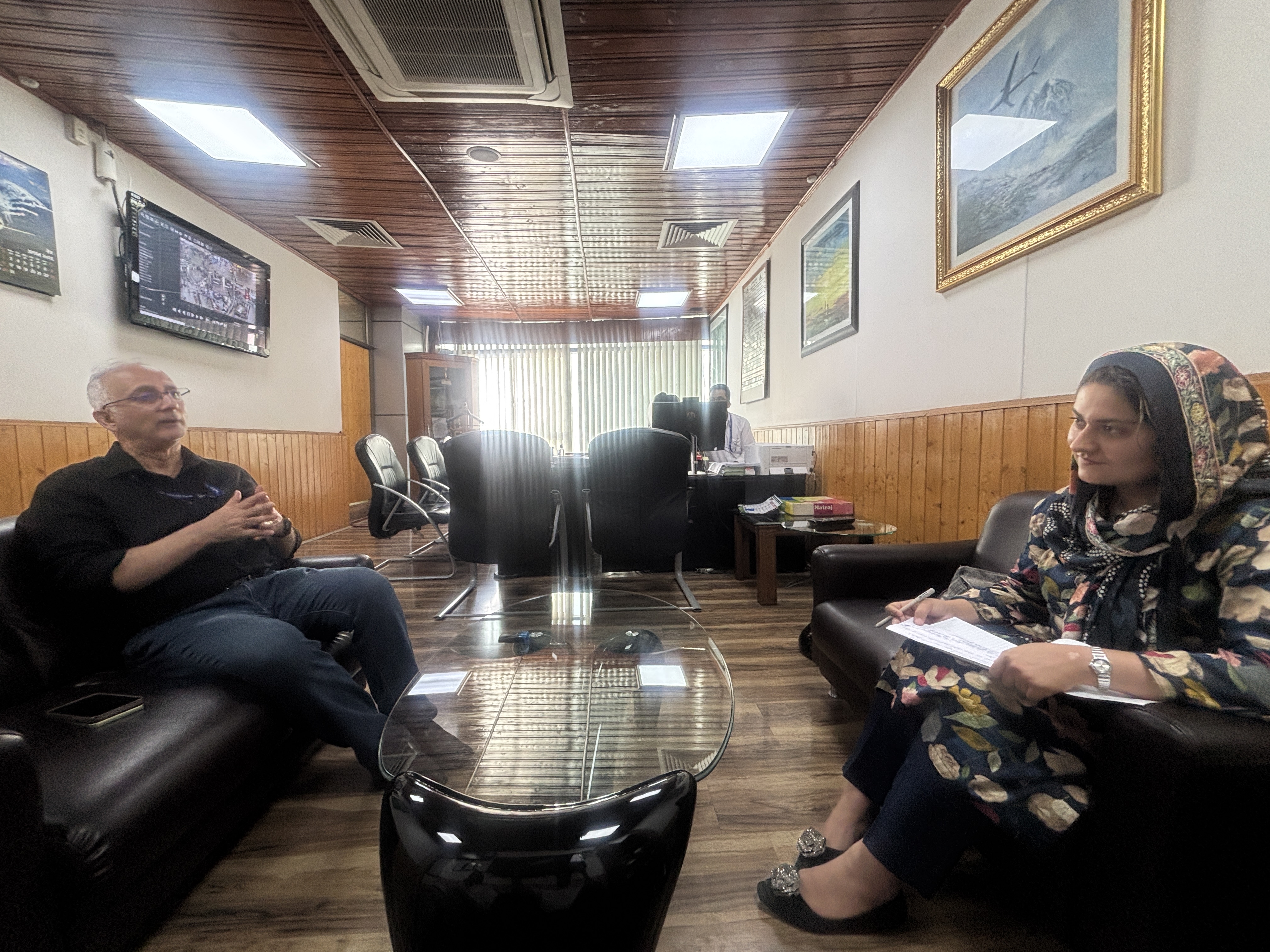
Srinagar Airport's ₹1,677-Crore Expansion: Building for the Next Decade
Kashmir Central Desk
In an interaction with Insha Sofi for Kashmir Central, the Director of Srinagar International Airport, Mr. Javed Anjum discusses the four-year expansion programme, the new terminal, increased passenger capacity, apron expansion, city connectivity and the challenge of transforming the airport while keeping it fully operational.
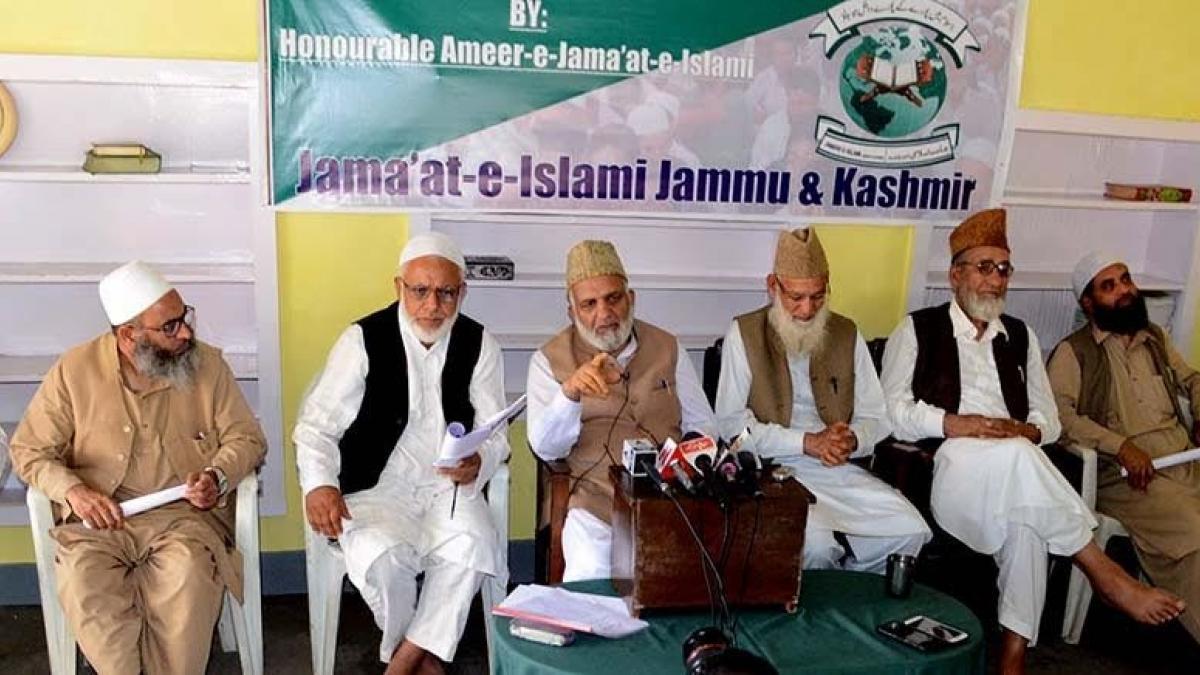
Jamaat’s Old Problem: The Politics of Compromise and Denial
Bashir Assad
The latest rupture within the banned Jamaat-e-Islami Jammu and Kashmir is being presented, understandably, as a dispute between the organization’s old guard and the group of its former functionaries who moved into electoral politics through the Justice and Development Front.
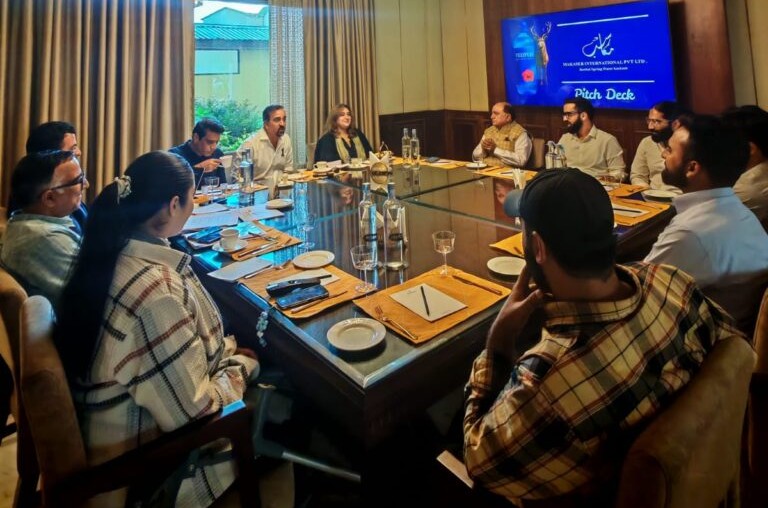
The Silicon Ravine: Global Capital, Remote Tech, and Kashmir’s Sovereign Digital Frontier
Sohail Bhat
In the quiet, low-lit cafes lining the Bund in Srinagar and within the minimalist co-working spaces cropping up across Srinagar and Jammu, a quiet macro-economic transformation is unfolding.
The Durbar Move Dilution and the Winter Secretariat Model
Kashmir Central Desk
For nearly a century and a half, the seasonal rhythm of governance in Jammu and Kashmir was dictated by a monumental administrative migration. Introduced in 1872 by Maharaja Gulab Singh, the bi-annual Darbar Move saw the entire government machinery-complete with thousands of employees, ministers, and truckloads of official files-pack up and travel across the treacherous Jammu–Srinagar National Highway.